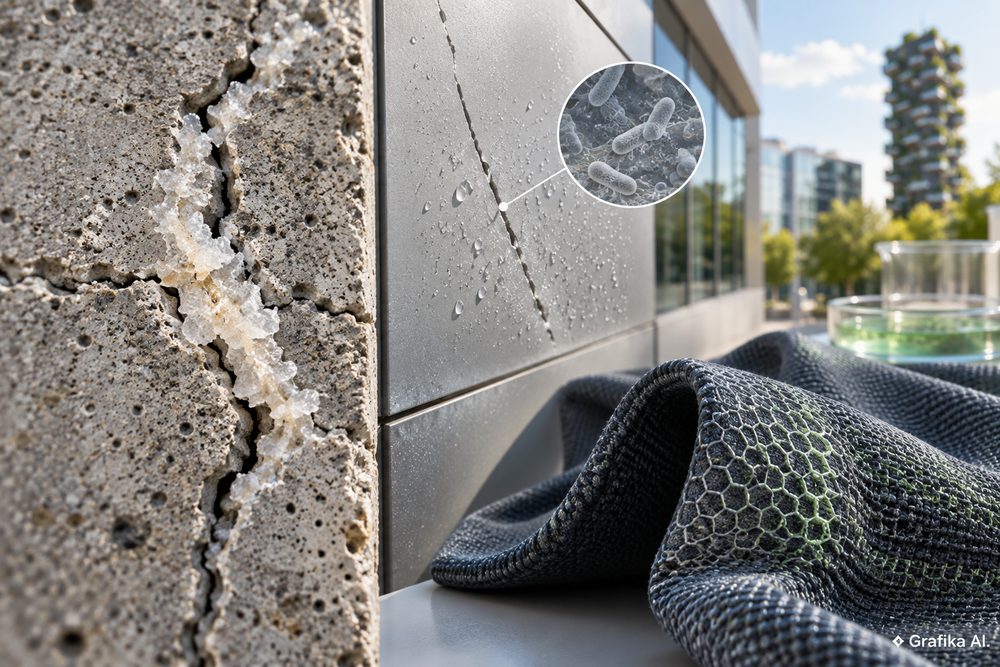
Concrete normally gives microbes almost everything they dislike: extreme alkalinity, little available food, periods of severe dryness and, during curing, a rapidly changing chemical environment. Yet concrete has become one of the most practical testing grounds for living materials. The trick is not to keep bacteria permanently active. It is to put the right microorganisms into the material in a form that can survive inactivity, then give them a job when conditions change.
That job might be filling a crack with calcium carbonate, signalling that a coating has been damaged, changing the shape of a fabric as humidity rises or producing a useful chemical. The microorganism stops being contamination and becomes a designed functional component.
This distinction matters. A material made by microbes is not necessarily a living material. Bacterial cellulose, mycelium panels and fermentation-derived polymers can be sterilised or dried until no viable organisms remain. They are biofabricated materials, but the biological system no longer performs a function during use. In an engineered living material, viable cells, spores or another biologically active component remain capable of responding, metabolising, regenerating or being reactivated.
What actually makes a material “living”
An engineered living material, usually abbreviated to ELM, combines a biological component with a physical matrix. Sometimes the microorganisms make that matrix themselves, as bacteria do when forming biofilms or bacterial cellulose. In other designs, engineers put cells into something else: a hydrogel, polymer, cementitious matrix, textile structure or microcapsule.
The interesting part is not simply that the cells remain alive. What matters is what they do.
Microbes can be programmed or selected to provide functions such as:
-
biomineralisation, where metabolic activity causes minerals such as calcium carbonate to precipitate;
-
self-repair, where damage creates the conditions that activate a dormant biological system;
-
sensing, for example responding to chemicals, humidity or mechanical damage;
-
reporting, including visible colour or fluorescence changes;
-
actuation, where changes in cellular dimensions physically move another material;
-
bioremediation, where organisms metabolise pollutants;
-
regeneration, where a living component grows again after part of the material has been removed.
That list explains why the field is more interesting than the phrase “bacteria inside concrete” suggests. The microorganism can act simultaneously as a chemical factory, sensor and repair system without conventional wiring or motors.
One particularly clear demonstration came from living building materials containing the cyanobacterium Synechococcus sp. PCC 7002. Researchers embedded the photosynthetic organism in a sand-gelatin scaffold. The cyanobacteria promoted calcium-carbonate mineralisation and the material could be successively regenerated through three generations. In samples stored at at least 50% relative humidity, microbial viability after 30 days was approximately 9-14%.
That experiment also exposes the central engineering problem. The conditions that benefit the organism are not always the conditions that benefit the structure. Greater dehydration improved some structural properties, but prolonged drying reduced microbial viability. A living material therefore has two sets of requirements: those of the building, coating or textile and those of the organism living inside it.
This conflict appears repeatedly in real products.
A bacterium may need water, while a protective coating is specifically designed to exclude water. A textile microorganism may need a humid microenvironment, while the garment has to survive drying, detergent and storage. Concrete bacteria must tolerate pore solutions commonly around pH 12.5-13.5, mechanical mixing and months or years without nutrients.
The usual solution is dormancy.
Spore-forming bacteria, particularly species from groups such as Bacillus and related alkaliphilic microorganisms, can be incorporated as spores rather than metabolically active cells. Spores need very little while dormant and tolerate conditions that would rapidly kill ordinary vegetative bacterial cells. Engineers can additionally protect them inside alginate hydrogels, porous aggregates, mineral carriers or specially manufactured pellets.
The living component therefore behaves less like a houseplant that requires continuous care and more like an emergency system stored inside the material.
There is another important correction to make: living does not automatically mean sustainable. A microbial function can extend service life dramatically, but the complete system may still require synthetic polymers, encapsulation materials, nutrients and energy-intensive processing. Sustainability has to be assessed over the product’s service life, including avoided repairs and replacement, rather than inferred from the presence of biology.
Concrete and coatings turn dormant microbes into a repair and sensing system
Concrete is an unusually good candidate for biological self-repair because small cracks create exactly the trigger that a dormant system can use: water enters where damage has occurred.
In a typical bacteria-based design, spores and a nutrient or calcium source are incorporated into the concrete or into protective capsules. When cracking allows moisture to reach the system, suitable spores germinate and microbial activity changes the local chemistry. Calcium carbonate, CaCO₃, then precipitates in or around the crack.
This process is commonly grouped under microbially induced calcium carbonate precipitation, or MICP/MICCP.
Not every bacterial concrete works through exactly the same metabolism. Ureolytic systems use bacterial urease to break down urea, producing conditions favourable for calcium-carbonate precipitation. They can mineralise efficiently, but ammonia-containing by-products are a genuine environmental drawback. Non-ureolytic pathways can avoid that issue and are therefore attractive for construction applications, although the kinetics and mineral production differ.
The practical question is crack width.
Ordinary concrete already has a limited ability to seal very small cracks through continued hydration and carbonate formation. Under favourable wet conditions, this autogenous healing is generally most effective for cracks below roughly 100-150 micrometres.
Engineered autonomous systems push beyond that range. Across bacterial and encapsulated systems, roughly 0.1-0.5 mm is a more realistic engineering range to investigate, although laboratory studies have reported healing approaching 1 mm under favourable conditions.
One hydrogel-encapsulation study achieved healing of cracks around 0.5 mm and reduced average water permeability by approximately 68%. Other experiments have reported bacterial crack closure approaching 0.97 mm. The Dutch company Basilisk, one of the better-known European commercial examples, markets a microbial concrete admixture with a claimed autonomous filling capacity of up to 1 mm, alongside a repair mortar and liquid repair system for existing structures.
Those numbers need to be read correctly. A 1 mm surface crack that appears visually filled is not the same thing as recovering the original structural capacity of the member.
That is the most common misunderstanding around self-healing concrete.
Crack closure, reduction in permeability and mechanical recovery are different measurements. Biological systems are particularly interesting because closing transport paths can restrict the movement of water, chlorides and other aggressive substances toward reinforcement. That can have a substantial durability benefit even when the original tensile or flexural capacity has not been fully restored.
For a reinforced concrete structure in Poland, this distinction matters more than a photograph of a white calcite-filled crack. The valuable question is whether the material reduces water penetration, chloride ingress and reinforcement corrosion risk through the expected service conditions.
The local climate adds another constraint. Outdoor concrete may experience wet-dry cycling, frost, de-icing salts and long periods at temperatures unsuitable for microbial metabolism. A biological system does not eliminate the need for correct freeze-thaw resistance, concrete cover, reinforcement design, drainage or crack-width control. Biological activity can slow or stop during cold or dry periods even if viable spores remain available for later reactivation.
For a real specification, I would ask for five things before accepting a self-healing claim:
-
the crack-width range actually tested, not simply the maximum crack ever closed;
-
water-permeability or sorptivity results before and after healing;
-
performance after realistic wet-dry and freeze-thaw cycles;
-
compatibility with the intended cement, supplementary cementitious materials and admixtures;
-
evidence from aged specimens, preferably including cracks introduced months rather than hours after casting.
The last point is easy to overlook. A system that heals a crack deliberately produced seven days after casting is not automatically evidence that the same mechanism will work after ten or twenty years.
Living coatings take the same idea in another direction.
Instead of placing microbes throughout a bulk material, spores can be distributed in a thin polymeric or mineral layer. Damage then becomes the trigger.
A 2026 research system, for example, incorporated bacterial spores into a synthetic polymer coating designed for structural crack detection. The polymer remained a physical barrier under normal conditions. When cracking occurred, the damaged region allowed hydration and biological activation, producing a fluorescent signal associated with the crack. In other words, the biological component acted as an embedded damage reporter.
Other experimental coatings use microbial mineralisation itself for repair. A cracked cementitious coating can expose dormant microorganisms to water and ions, after which calcium-carbonate deposition obstructs the pathway through which corrosive species would otherwise travel.
This opens a useful design direction: the same surface could eventually detect damage first and repair it second.
It is not yet normal industrial coating technology. Self-healing coatings of many types have produced excellent laboratory results, while widespread field deployment remains limited by ageing, manufacturing repeatability, UV exposure, abrasion and the difficulty of proving reliable activation after years of service.
For construction products in Poland and the rest of the EU, the certification route also matters. Regulation (EU) 2024/3110, the new Construction Products Regulation, has applied in substantial part since 8 January 2026, with a transitional period during which product families move from the previous CPR framework. An innovative construction product outside the scope of a relevant harmonised specification may use the European Technical Assessment, or ETA, route where the applicable requirements are met.
That paperwork is not a formality with living systems. Designers need declared performance for the construction function, not merely microbiology showing that the bacteria survive.
Fabrics show what happens when microbes become sensors and actuators
Living textiles face a harder problem than concrete. A concrete bacterium can spend most of its life protected inside an alkaline matrix. A microbe incorporated into clothing may encounter sweat, oxygen, UV, friction, detergent, repeated drying, skin microorganisms and washing temperatures that change dramatically from one use cycle to another.
That makes textiles difficult to commercialise — but scientifically very useful.
A well-known biohybrid wearable experiment published in 2017 showed just how much mechanical work microbial cells can perform without a motor. Researchers deposited microbial cells as layers approximately 1-5 μm thick onto natural latex sheets around 150-500 μm thick.
At about 15% relative humidity, dehydration caused the cell layer to contract and the film to bend. At around 95% RH, the cells absorbed moisture and the film flattened again. The response occurred within seconds and could be repeated.
The group used the effect to produce prototype running apparel with flaps that opened as humidity increased. Microorganisms therefore served as microscopic humidity-driven actuators rather than as a decorative biological ingredient.
The attraction is obvious. A conventional smart textile normally needs some combination of a sensor, power source, controller and actuator. A biological material can potentially combine several of those functions in one microscopic system.
The difficulty is equally obvious: a prototype responding repeatedly in a controlled laboratory chamber is not the same as a garment that survives 50 domestic washing cycles, months in a wardrobe, detergent chemistry, skin contact and mechanical abrasion.
That gap explains why some of the most promising living-fabric work is moving away from ordinary clothing.
In 2023, researchers demonstrated photosynthetic living fibres produced through coaxial extrusion-based 3D printing. Algae and bacteria could be spatially organised inside hydrogel fibres and used together for bioremediation. This is much closer to a living reactor in fibre form than to a T-shirt.
Research published in 2026 has pushed the concept further with living fungal textiles. A platform based on Cordyceps militaris maintained metabolically active mycelium in cohesive macroscopic films. Nutrient exposure could induce new hyphal growth at the surface, effectively creating a form of biological surface renewal. The researchers also demonstrated microbial partners for functions such as pigmentation and UV shielding. Under the reported degradation conditions, the material showed near-complete morphological degradation within 41 days.
These developments suggest that the first genuinely useful living textiles may be filters, environmental sensors, bioremediation fabrics, architectural membranes or replaceable functional layers — not everyday shirts.
Before selecting a living textile, there are several uncomfortable questions that should be answered first.
How is viability maintained during storage? A product that needs constant humidity before installation creates a logistics problem.
What happens during cleaning? Detergents, preservatives and antimicrobial treatments can destroy the organisms responsible for the advertised function.
Can organisms or spores leave the material? Abrasion and shedding matter much more in a wearable product than in microorganisms trapped deep inside concrete.
What happens when the material is damaged or disposed of? A biodegradable carrier and a biologically safe living system are separate requirements.
Is the microorganism genetically modified? If so, EU biosafety rules add another layer of assessment. Directive 2009/41/EC governs contained use of genetically modified microorganisms, while applications involving environmental release can engage separate GMO legislation.
Claims also change regulatory obligations. A textile or coating intentionally marketed as antibacterial or antifungal can fall within the EU Biocidal Products Regulation, Regulation (EU) No 528/2012. Treated articles may only use relevant active substances permitted for that purpose and can be subject to specific labelling requirements. A microorganism incorporated solely to mineralise a crack is not automatically a biocide; what the product is designed and marketed to do matters.
This is why “contains beneficial bacteria” is not enough information for procurement.
For a serious project, the specification should identify the organism or biological system, its intended function, activation conditions, expected lifetime, containment method, performance test and end-of-life route. If one of those fields is missing, the technology is still being described as a concept rather than as an engineering product.
FAQ
Are living materials literally alive all the time?
No. Many of the most practical systems deliberately use dormant spores. Biological activity starts only after a defined trigger such as moisture, nutrients or damage creates suitable conditions.
Can bacteria in concrete repair a large structural crack?
Not reliably. Biological self-healing is primarily a microcrack and durability technology. Around 0.1-0.5 mm is a useful range for evaluating many autonomous systems, while selected studies and commercial systems report crack closure approaching 1 mm. A wide, moving or structurally significant crack still requires engineering assessment and conventional repair where necessary.
Does a healed crack regain its original strength?
Not necessarily. Surface closure and recovery of watertightness are considerably easier to achieve than complete mechanical recovery. Always check which performance parameter was actually measured.
Are microbial self-healing materials commercially available in Europe?
Yes, particularly in the concrete sector. Products such as microbial concrete admixtures and repair systems are already sold commercially. In contrast, many advanced living coatings and living textiles remain at laboratory, prototype or pilot stage.
Will bacteria continue working after years inside concrete?
Long-term survival is one reason spore-forming organisms and protective encapsulation are used, but service lives measured in decades cannot simply be assumed from short laboratory experiments. The relevant evidence is performance after ageing and delayed cracking, not initial bacterial viability alone.
Are living materials safer than conventional chemical materials?
That is the wrong comparison. Safety depends on the strain, exposure route, containment, genetic modification, metabolites and intended use. A well-characterised non-pathogenic spore system embedded inside concrete presents a very different exposure scenario from viable engineered microorganisms on a wearable textile.
Does “living” automatically mean biodegradable?
No. The microorganism may be biodegradable while the supporting matrix contains conventional polymers. Conversely, a biodegradable material may contain no living organisms during use.
Are living materials automatically better for the climate?
No. Their strongest environmental argument is often service-life extension: preventing water ingress or corrosion can delay repair and replacement of carbon-intensive materials such as reinforced concrete. That benefit has to outweigh the impact of encapsulation, nutrients, manufacturing and end-of-life treatment.
What should an architect or engineer in Poland check first?
Start with the claimed function and exposure conditions. For concrete, check crack width, moisture availability, frost and chloride exposure and documented durability performance. For a construction product, verify the applicable CPR documentation and CE/ETA route. For coatings or textiles making antimicrobial claims, check the Biocidal Products Regulation implications. For genetically modified microorganisms, establish the relevant biosafety route before specifying the product.
The first decision should therefore have nothing to do with whether a material sounds innovative. Start with the failure mode. If the costly problem is recurring water ingress through small concrete cracks, a microbial self-healing system is worth testing against a defined crack-width and exposure specification. If the problem is loss of structural capacity through a large or moving crack, biology is not the first repair tool. For coatings and textiles, demand ageing, cycling, abrasion or washing data before being impressed by biological responsiveness. The first mistake to remove is specifying a material because it is “living” rather than because its microbial function solves a measurable engineering problem.