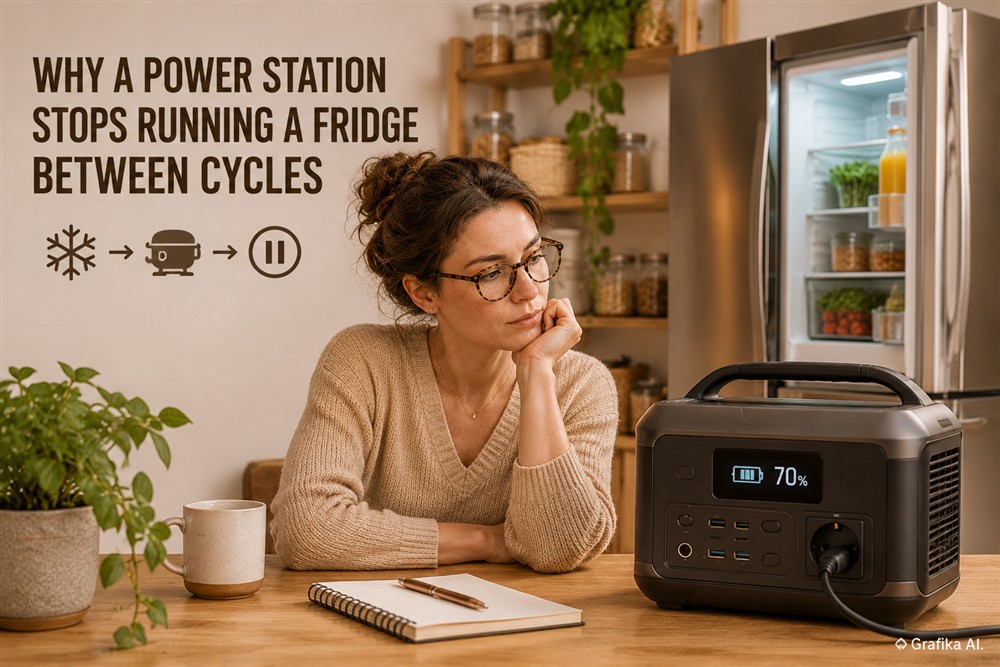
A refrigerator does not draw the same amount of power continuously. Its compressor switches on when cooling is needed and stops once the required temperature is reached. During this pause, the refrigerator still uses electricity, but its consumption can drop to just a few watts. That small change is enough to trigger the automatic shutdown function on some portable power stations.
The result is confusing: the refrigerator works normally for several minutes, the compressor stops, and then the power station switches off its AC output. When the thermostat calls for cooling again, the compressor cannot restart because the socket is no longer supplying electricity.
In most cases, the problem is not insufficient battery capacity or a faulty refrigerator. It is a mismatch between the refrigerator’s operating cycle and the power station’s low-load detection settings. Understanding that distinction is essential before replacing equipment or buying a more powerful unit.
Why a Refrigerator’s Power Consumption Drops Between Compressor Cycles
A conventional household refrigerator operates in cycles. Its thermostat monitors the internal temperature and activates the compressor when additional cooling is required. Once the target temperature is reached, the compressor switches off.
For a typical refrigerator compressor, the operating power is approximately 100–300 W, with a steady-state current of around 0.5–3 A at 220–240 V. These values depend on compressor design and refrigerator size. At startup, the current can reach up to four times the normal operating current.
The important detail is what happens after the compressor stops.
The refrigerator does not become completely disconnected from the electrical supply. Several components may remain active:
-
Control board: monitors temperature and manages the cooling cycle.
-
Temperature sensors: continuously measure conditions inside the refrigerator.
-
Display and electronic controls: remain in standby mode.
-
Internal fans: may continue operating, depending on the refrigerator’s design.
-
Defrost system: can activate periodically, particularly in No Frost models.
Although these components continue consuming electricity, their combined demand is often considerably lower than the compressor’s operating power. In some refrigerators, the standby load falls below 10 W.
This creates a problem for a portable power station equipped with automatic low-load protection.
The station measures the electricity drawn from its AC outlets. It does not understand that the refrigerator is temporarily resting and will need power again in 20 or 30 minutes. It simply detects that the connected appliance is drawing very little electricity.
If the measured load remains below the station’s programmed threshold for long enough, the inverter may switch off the AC output.
There is also an important distinction between refrigerator designs. Traditional fixed-speed compressors switch between operating and resting periods. Modern inverter compressors adjust their speed electronically and can operate at lower power for longer periods. Their consumption pattern is different, but a sufficiently low demand can still trigger an unsuitable power-saving setting.
ECO Mode, Low-Load Detection and Automatic AC Shutdown
Not every power station uses the same shutdown mechanism. Two functions are particularly important when powering a refrigerator: ECO mode and AC output timeout.
They are related, but they do not work in exactly the same way.
1. ECO mode and minimum load thresholds
ECO mode is designed to reduce unnecessary battery consumption. When the connected appliance draws less power than a predefined threshold for a specified period, the station automatically disables its output.
The BLUETTI AC180P provides a useful example of how this works.
Its ECO settings allow the AC output threshold to be configured between 15 W and 30 W, with shutdown delays of 1, 2, 3 or 4 hours. If the refrigerator’s measured consumption remains below the selected threshold for the configured period, the AC output can switch off.
Consider a refrigerator that draws 150 W while its compressor operates but only 5 W during a cooling pause.
With a 15 W threshold, the refrigerator’s standby consumption is insufficient to keep the output active if it remains below that level for the selected period.
The station is behaving according to its settings. The problem is that those settings are unsuitable for this particular appliance.
The first step is therefore to check whether ECO mode is enabled. If the power station allows it, disable low-load shutdown when running a refrigerator.
2. AC output timeout
Some power stations use a separate automatic shutdown timer for their AC outlets.
The EcoFlow DELTA 2, for example, specifies automatic AC output shutdown after 12 hours without a detected load. Its manufacturer explicitly warns that intermittent appliances, including refrigerators and air conditioners, can trigger this function.
The EcoFlow app allows the AC timeout interval to be configured to Never.
This is an important setting when the station needs to supply an appliance continuously rather than operate as a temporary charging source.
Do not confuse this function with the power station’s display sleep mode. A screen switching off after several minutes does not necessarily mean that the AC inverter has stopped supplying electricity.
3. Distinguishing a low-load shutdown from an overload
The timing of the failure provides a useful diagnostic clue.
| Observed behaviour | Most likely explanation |
|---|---|
| AC output switches off during a long compressor pause | Low-load detection or ECO mode |
| AC output switches off after a fixed period | AC timeout |
| Power station shuts down when the compressor starts | Startup surge or overload protection |
| Entire power station switches off at a low battery level | Battery discharge limit or protection |
| AC output stops after prolonged operation in a hot environment | Possible thermal protection |
This distinction matters because increasing the inverter’s rated wattage will not correct an incorrectly configured low-load shutdown.
How to Keep a Refrigerator Running Continuously on a Power Station
The most effective solution is to configure the existing equipment correctly before spending money on a replacement power station.
Follow these steps in order.
Step 1: Disable automatic low-load shutdown
Open the power station’s settings or mobile application and look for options such as:
-
ECO Mode
-
AC ECO
-
Low Load Shutdown
-
Power Saving Mode
-
AC Output Timeout
-
Automatic AC Shutdown
Disable the low-load shutdown function or select a continuous-output operating mode.
If the station provides an AC timeout setting, select Never where supported.
Keep the battery’s low-voltage and other protective limits enabled. Disabling automatic energy-saving functions does not mean disabling battery protection.
Step 2: Measure the refrigerator’s actual power consumption
Do not rely exclusively on the wattage printed on the refrigerator’s identification plate.
That figure describes a rated operating condition, not necessarily the power drawn throughout every cooling cycle.
Use a suitable 230 V plug-in energy meter to record:
-
Power consumption while the compressor is running.
-
Consumption after the compressor stops.
-
Duration of each cooling cycle.
-
Energy consumption over 24 hours.
For a more accurate assessment of the startup surge, use a clamp meter with an inrush-current measurement function or have an electrician perform the measurement.
An ordinary energy meter may not capture a very short startup peak.
The objective is to establish whether the problem is caused by low standby consumption or by insufficient startup capability.
Step 3: Check inverter capacity and output quality
Even if low-load detection is disabled, the power station must be capable of starting the refrigerator.
For a conventional compressor, the startup current can reach approximately four times its steady-state value. A station rated for 300 W of continuous output, for example, is not automatically suitable for a refrigerator that normally consumes 150 W.
Check three parameters:
-
Continuous AC output: must cover the refrigerator’s operating demand and any other appliances connected simultaneously.
-
Surge capacity: must accommodate the compressor’s starting requirements for the necessary duration.
-
Output waveform: choose a pure sine wave inverter supplying the refrigerator’s required 230 V, 50 Hz AC power.
A pure sine wave output is the safer choice for refrigerators with electronic controls and modern compressor systems.
Also check the manufacturer’s specifications for the surge rating. A high peak-wattage figure without a stated duration is not enough to establish compatibility.
Step 4: Calculate the energy requirement, not just the wattage
A refrigerator may consume relatively little energy over 24 hours despite drawing several hundred watts while the compressor is operating.
The EU energy label provides a useful starting point because it states annual electricity consumption in kWh.
For example, a refrigerator rated at 200 kWh per year has a calculated average consumption of:
200 ÷ 365 = approximately 0.55 kWh per day.
This is an estimate based on standardized testing, not a guarantee of actual household consumption.
There is another factor that is easy to overlook: the power station itself consumes energy when its AC inverter remains switched on.
For example, an inverter drawing 12 W without an external load consumes:
12 W × 24 hours = 288 Wh per day.
The 12 W figure is illustrative, not a universal specification. Check the manufacturer’s no-load consumption figure or measure the actual battery-side draw.
For extended operation, this overhead can materially reduce the available runtime. A larger battery may therefore be necessary even after the shutdown problem has been corrected.
Step 5: Test the complete setup before relying on it
After changing the settings, connect the refrigerator and run a supervised test lasting at least 24 hours.
Monitor the following:
-
Whether the AC output remains active throughout compressor pauses.
-
Whether the compressor restarts without an overload warning.
-
Whether the power station maintains a sufficient battery reserve.
-
Whether the refrigerator maintains the required internal temperature.
-
Whether a periodic defrost cycle causes any unexpected interruption.
Use an independent refrigerator thermometer rather than relying solely on the appliance’s display.
For food storage, aim for a refrigerator temperature of around 4°C and a freezer temperature of -18°C.
Do not use an untested power station as the sole source of electricity for temperature-sensitive medicines or valuable frozen goods.
One workaround to avoid: connecting an additional lamp or resistive appliance to keep the power draw above the ECO threshold.
Although this can sometimes prevent low-load shutdown, it wastes stored energy. A continuous 20 W dummy load consumes 480 Wh every day, even when the refrigerator does not need additional cooling.
Disabling the unsuitable automatic shutdown function is a much better solution.
FAQ: Common Questions About Power Stations and Refrigerators
Why does my power station switch off only when the refrigerator compressor stops?
The refrigerator’s power consumption falls during the cooling pause. If it drops below the station’s minimum load threshold for long enough, the automatic shutdown function disables the AC output.
Will buying a power station with a higher wattage rating solve the problem?
Not necessarily. A higher continuous or surge rating does not automatically change the minimum-load threshold. If ECO mode is responsible, changing its settings is the first solution to try.
Can a refrigerator run continuously with ECO mode disabled?
Yes, provided the power station supports continuous AC output, has sufficient battery capacity and can handle the compressor’s startup demand. Its battery will discharge even during compressor pauses because the inverter remains active.
Is it better to use a 12 V DC output instead of an AC socket?
Only if the refrigerator is specifically designed to operate from that DC voltage and its current requirements are compatible with the output. A standard 230 V household refrigerator should normally be connected through a suitable AC inverter.
How can I tell whether the problem is low-load detection or compressor startup surge?
If the AC output switches off after the compressor has stopped, investigate ECO mode and AC timeout first. If the station displays an overload warning precisely when the compressor tries to restart, investigate the startup current and inverter surge rating.
Start with the power station’s ECO mode and AC timeout settings, not its advertised wattage. Disable low-load shutdown, set the AC timeout to Never if available, and test the refrigerator through a complete 24-hour operating cycle. Only if the station then trips when the compressor starts should you move on to checking surge capacity or considering a different power station.